New Rules from The Mothership

If this sounds like a sales-pitch, well, it sort of is. We are excited!

There have recently been a whole bunch of new stuff announced by SBA which aims to simplify the process to apply and qualify for a loan and to increase access to capital. As we wait on the details (welcome to our world), we are especially excited about two of the new items.

First, the SBA is relaxing affiliation rules and doing away with the franchise registry. That’s a big deal around here. We are very active in franchise finance including startups, acquisitions and expansions and anything the agency does to simplify the process opens up opportunities for more entrepreneurs to pursue their dreams.

Second, which will probably make an even bigger impact on capital access is the ability to use SBA loans for partial equity purchases. We are still waiting on the exact wording, but the change in rules appears to open the door to another financing tranche that’s been effectively used in private equity for many years. If it does what we think it does, a daughter will be able to buy into her parents’ business with limited resources, assisted by an SBA loan. That’s just one example of the many, many opportunities that will now be available to small business borrowers!

Stay tuned for more developments and reach out to us to take advantage of these exciting changes. Our Gulf Coast Small Business Lending team is here to help.
I don’t know everything, but I know something

Like many of you I’ve been glued to the financial news outlets over the past ten days, witnessing the SVB and Signature trainwrecks and watching for signs of contagion.  I think that both of those banks were operating on the edge (and went over), and I think that the actions taken by the regulators will proof us against contagion. But I have to admit to myself that I don’t really know.  

But inaction, even in the face of uncertainty, is not an option for a commercial SBA lender like Gulf Coast Small Business Lending. So, we reflect on what we do know (the basics), and continue to follow the rules and practices that have worked well for us in the past:

  1. We don’t invest in what we don’t understand.  That’s where the risks hide, and if we don’t understand them, we can’t plan for them.  If you apply for an SBA loan from Gulf Coast Small Business Lending, please be prepared to explain to us what your business is since there is a good likelihood we don’t understand it as well as you do.
  2. Once we understand the risks and determine that we can accept them, we make the move.  We are SBA lenders. There is no use for us unless we lend, and our job can be summed up as “understand the risks and make the investments.”  Not making loans is simply not an option.
  3. We stay in our lane. Our product, the SBA 7(a), is specialized and highly regulated.  We have an SOP and the resources of the SBA to help us ascertain eligibility when we are stumped by a unique situation. So, we go all out to support borrowers, but only within the guardrails that are in place.  We stay firmly in our SBA lending lane.
  4. We diversify, diversify, and diversify. And did I mention that we diversify?

My team and I are available to talk with you if you have questions or concerns or simply want to talk through an SBA loan scenario.  You can reach out to me through LinkedIn and my team through the Our People page on our website.

Can-do Through Strength

This one will sound like a sales pitch, but it is not the intent.

We are probably entering a recession, my fifth as a working adult. In ’91 I was leaving a great job as a scientist to return to school, wondering what kind of a job market would be waiting for me on the other side. In ’01 I had recently started a new assignment running a textile company. In ’08 I started a new job at a small specialty finance company. The one in ’20 was a blur: fast and furious as we deployed hundreds of millions of dollars in PPP loans to do our part to support small businesses.

It all worked out okay. The cycle smoothed out and for every month of uncertainty and distress there was a year of prosperity and growth.

Here at Gulf Coast Small Business Lending, we aren’t “preparing” per se for the next one. We have never been stronger and more stable, and we are using this period of uncertainty to continue building the team while taking care of our existing borrowers and seeking out new ones.  The recession will come and go, and the following few years will be the best we’ve ever had. SBA loans are here to stay, and we’ll be here to support small businesses whether we’re in a recession or not.  I remain bullish about SBA lending.

Financing Turnarounds

Binyamin Zak

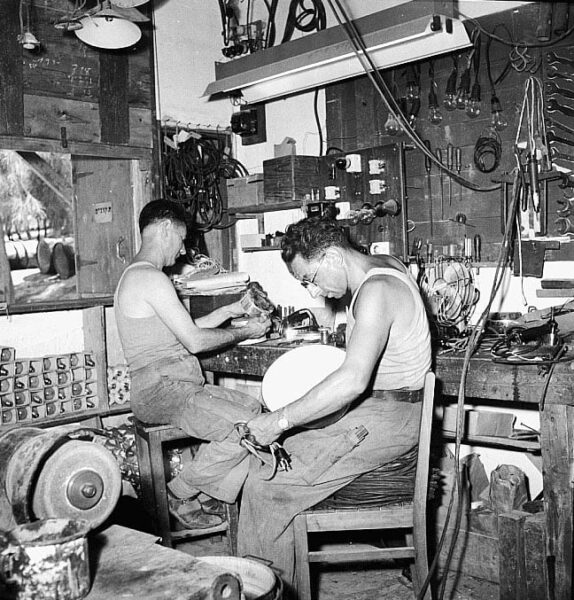
I understand the allure of fixing things. Growing up I spent a lot of time with my grandfather, an electrician (he’s the one in the foreground of this photo) and rewired a broken fan before I hit eight. I get it. It’s exhilarating to find an object (or a company) in rough shape and know it can be fixed. Probably. Maybe.

As SBA lenders we frequently receive request for SBA loans to finance turnarounds and I thought it might be useful to give our perspective on what we look for when we consider financing turnarounds.

Let’s begin with a general observation and if you go no further reading, consider this – it always takes longer and requires more capital than anticipated to return a company to profitability. With that in mind, and stating the obvious, plan for it.

More specifically, here is what we like to see:

  1. Prepare a 2-year weekly or monthly cash flow model. Not net income and not EBITDA, but real free cash flow taking into consideration working capital and capital expenditures. Stress that model by extending the loss-period and loss-depth.
  2. Using that model, realistically analyze how much capital it would take to affect the turnaround. Look at the cumulative loss at its lowest point and be sure to reserve enough liquidity with some cushion to fund it.
  3. Determine what went wrong in the first place. We would like to understand the experience, insight, and resources you bring to the project to make sure the turnaround is accomplished and the company returns to profitability.
  4. Turnarounds, like startups, require a higher injection of cash equity relative to the debt they take on. Amortizing term debt in particular is inflexible once it is disbursed and should be used sparingly.

Got a turnaround you’d like us to look at? Reach out to us today and we will quickly tell you whether we can help.

Help Me Understand

From young age through college and grad schools, I don’t recall anyone ever calling me “stupid.” I was a good student, attentive and curious. At my various jobs as a scientist and management consultant I wasn’t considered “dumb.” My bosses complimented my analytical capabilities and my ability to quickly understand complex issues.

I then transitioned to principal investing: private equity, structured debt, and now SBA lending. And all of a sudden, I was being told “you don’t get it.” Sometimes accompanied by indecipherable jargon, fast-talking, eye-rolling and hand-waving.

Case in point: cryptocurrency.

As part of our jobs as lenders we have to evaluate opportunities and make investment decisions on businesses we may know little about. We take the task seriously, we study, and we ask questions. Many of these opportunities are funded once we understand them.

Advice to entrepreneurs: Be patient with us. We are smart but we don’t know your business as well as you do. Expect “dumb questions” and as you prepare to speak with us know that we are genuinely interested to learn.

Note to underwriters: Don’t approve loans to businesses you don’t understand.